
Announcements & Events

Take Action for Birds by Friday, Jan. 23!!

LVAS Environmental/Conservation Note:

We begin the new year with a few glimmers of hope for birds, the environment and us. By taking a couple of simple actions, each of us can make those glimmers a little bit brighter: 

 Take Action for Birds by Friday, Jan. 23!!

1) Oppose -- no later than Friday, Jan. 23 -- a federal plan to vastly expand off-shore oil drilling, including in the high Arctic. More than 200 bird species nest in the Arctic; oil spills and habitat disruption from oil rigs are only two of the ways this plan could prove devastating for birds. You can voice your opposition using forms from Earthjustice or the Center for Biological Diversity. As always, be sure to personalize your comment by changing some of the words or adding your own thoughts. 

If, like me, you sometimes feel your comments will fall on proverbial "deaf ears," take heart: These comments don't just tell the government how you feel; they also help build a case that environmental litigators will use to try to stop the most destructive Trump administration policies in the courts. 

2) Oppose the Senate version of the SPEED Act, a measure that would gut the National Environmental Policy Act, fast-tracking drilling / mining and other potentially destructive projects by eliminating environmental and judicial review and cutting the public out of the decision-making process. Unfortunately, Lehigh Valley Congressman Ryan Mackenzie voted for the SPEED Act To try to make sure it doesn't become law, use this American Bird Conservancy link to contact your Senators.

3) Closer to home, urge your Pennsylvania lawmakers to make our state the first in the nation to ban the highly toxic herbicide Paraquat, which is deadly to birds. A House bill to ban Paraquat -- HB 1135 -- has already been introduced, and a version with bipartisan support is being prepared in the Senate. For more information and to contact your lawmakers, click here

Now, for a little good news: The U.S. House and Senate passed a 2026 limited spending package that mostly continues current funding levels for several agencies important to birds -- the Department of Interior, the U.S. Forest Service, the National Oceanic and Atmospheric Administration and the U.S. Environmental Protection Agency. While far from perfect -- the bill cuts climate research and does nothing to solve chronic agency under-funding, for example -- it is a significant improvement over Trump's request for drastic cuts in environmental programs. 

All of our federal lawmakers voted for this funding bill. When Rep. Mackenzie voted yea, however, it included almost 150 anti-environment riders -- all thankfully removed by the Senate. If you feel motivated to thank Mackenzie for his vote on the bill, be sure to also mention that you were grateful the Senate dumped all the riders, and that you were disappointed in his support of the SPEED Act.  

Thanks, on behalf of the birds!

-- Liz Brensinger, Conservation Chair
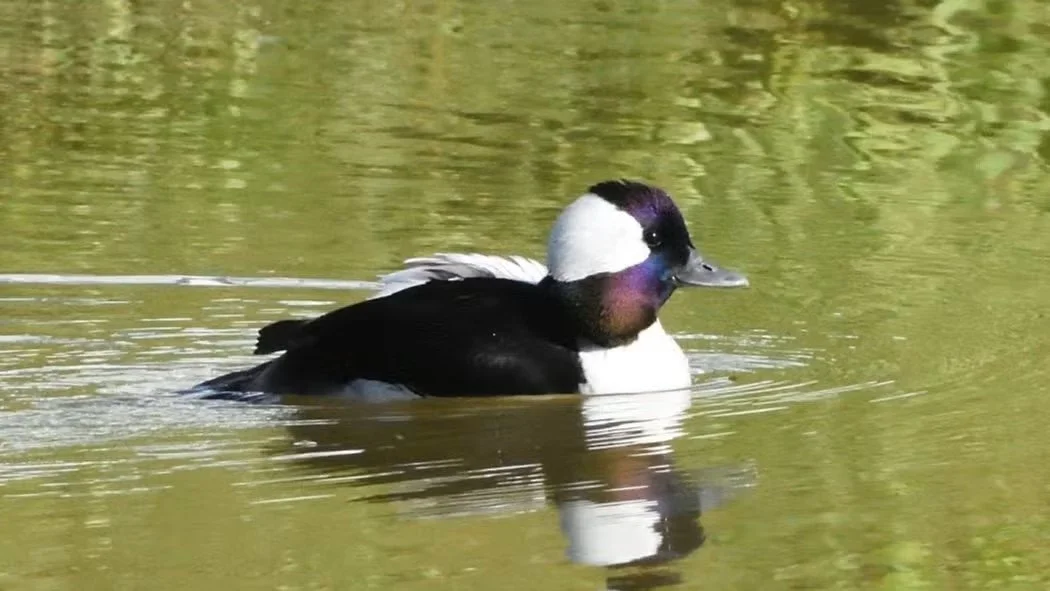
Bird Watching Field Trip to Allentown Lakes

join lvas president, Barbara Malt, to check out some local lakes in Allentown for waterfowl and other birds.

Saturday, Jan 17 · 9:00 AM to 11:30 AM EST

These lakes are spring-fed and do not typically freeze, attracting a nice variety of waterfowl in the winter. We will begin at Trexler Memorial Park, and then will drive to a couple other local lakes.

Bufflehead photo by Dave DeReamus

Meet at the Trexler Memorial Park parking lot off Springhouse Road (40.590167, -75.529470)
Leader: Barbara Malt (610-657-2582)

Never miss a guided walk or other LVAS event; become a member of our chapter!

Winter Ducks of Pennsylvania Presentation

learn about wintering ducks.

Friday, Jan 16 · 7:00 PM to 8:30 PM EST

For those that missed this LVAS Zoom program on January 16 or those who wish to see it again, use this link to access the program recording: https://www.youtube.com/watch?v=gefMHzu2iDc

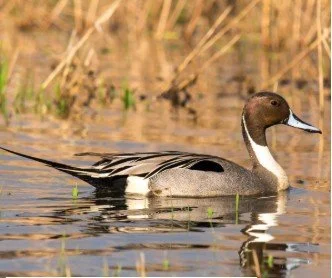
Photo of Northern Pintail Photo credit Mick Thompson

Northern Pintail Photo credit: Mick Thompson

This talk will provide an overview of dabbling and diving ducks that can be seen in winter in the Lehigh Valley. We will discuss the variety of ducks found here, their habits and habitats, why they are here, and how they survive Pennsylvania winters.

Perfect for beginning and intermediate birders who would like to get to know the wintering ducks.
We hope you can join us.

Never miss a presentation or other LVAS event; become a member of our chapter!

Lehigh Valley Christmas Bird Count 2025

Brandon Swayser

This year will mark the 126th annual Audubon Christmas Bird Count (CBC), the world’s longest-running citizen science project and wildlife census.

The Lehigh Valley Christmas Bird Count will take place on Saturday, December 20, 2025. This will be the 82nd year of our count.

The Lehigh Valley Audubon Society (LVAS) administers the annual Lehigh Valley Christmas Bird Count, and several other counts occur nearby, any of which could use your help!

We are looking for 2 types of volunteer participants in our designated circle, feeder-watchers and extra counters.

Feeder-watchers who live within this circle are needed to accurately identify all species commonly seen in their yard.  They count birds for any length of time on the 20th and report your sightings on a datasheet that we will provide.

Extra counters will be placed on one of our 12 area leaders' teams, within our designated circle, to drive/walk most of the day to count birds.

We hope you can join us!

If you have any questions, please feel free to contact LVAS’s count complier Brandon Swayser at brandon.swayser@davincisciencecenter.org

What is the Christmas Bird Count?

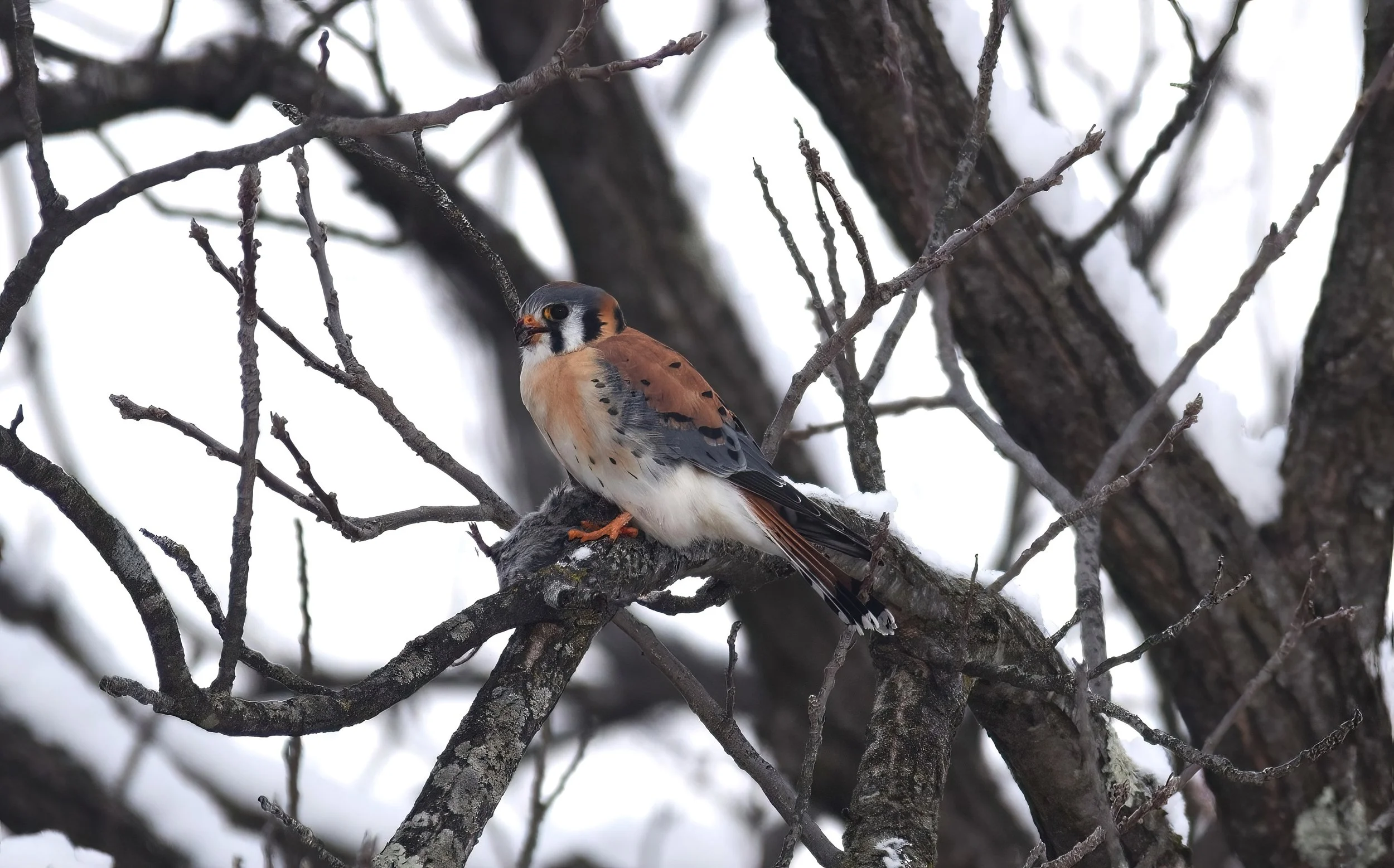
American Kestrel photographed during the 2024 Lehigh Valley CBC

American Kestrel photographed during the 2024 Lehigh Valley CBC

For those of you who are unfamiliar, the CBC is an annual volunteer-run census of birds that takes place across the western hemisphere from December 14th through January 5th every year. It is made up of thousands of local counts, each lasting 24 hours, covering a 15-mile wide diameter circle of land, and organized by a count compiler. Teams of volunteer counters typically split up areas of the circle and drive and/or walk those areas for up to 24 hours straight, recording the birds that they observe. Christmas Bird Counts are rich in tradition and camaraderie, and due to their thorough nature, often turn up some pretty incredible birds! For many birders, the CBC is one of the highlights of their year, a chance to catch up with old friends, see some rare birds, and above all else, contribute meaningful data to one of the worlds’ most powerful conservation science studies.  

That sounds great and all, but isn’t really my cup of tea, how else can I help?

It’s understandable that spending 12+ hours straight birding in the cold isn’t for everyone, but there is another way in which most people can participate, and that is by being a feeder-watcher. Feeder-watchers spend a portion of their area’s count day observing their backyard birdfeeders, or any birds in their yard or local greenspace, and report their sightings to their area’s compiler.


Here are a few easy steps for getting involved as a feeder-watcher: 

  1. Determine which (if any) circle your backyard is in by going to:  https://www.audubon.org/community-science/christmas-bird-count/join-christmas-bird-count. Click the bold link on that page that says “click here for a map view of circles expected…” and zoom in to your home area on the map. If you are in a circle on that map, click the yellow bird icon in that circle and you will see the count date, and compiler’s contact info. This map may not be updated until November.

  2. Contact the compiler to see if you can sign up to be a feeder-watcher for that count. Don’t wait until the last minute. 

  3. On the day of the count, keep a checklist of all bird species you see at your feeders, recording only the highest number of each species that you saw at one time - birds will often visit feeders many times over the course of the day, so this part is important. You also must record your effort - the amount of time that you spent counting birds in your yard and the number of observers who counted with you.

  4. Finally, follow your compiler’s instructions (usually a simple email) for reporting your observations. 

Why is the CBC important?

By conducting a standardized survey of birds on the same date, in the same location, with the same methods, and usually by the same people year after year, we gain incredibly valuable data on long term changes in bird populations. CBC data has been the first alert to many population trends over the years and has made an immense impact on avian conservation science. Count data has pointed out downward population trends like that of Evening Grosbeaks and Common Grackle and has helped to inform scientists and catalyze the next steps of conservation work to help these species. Additionally, the CBC is a great way to get new birders involved and grow our team of citizen scientists, and hey, it’s fun!

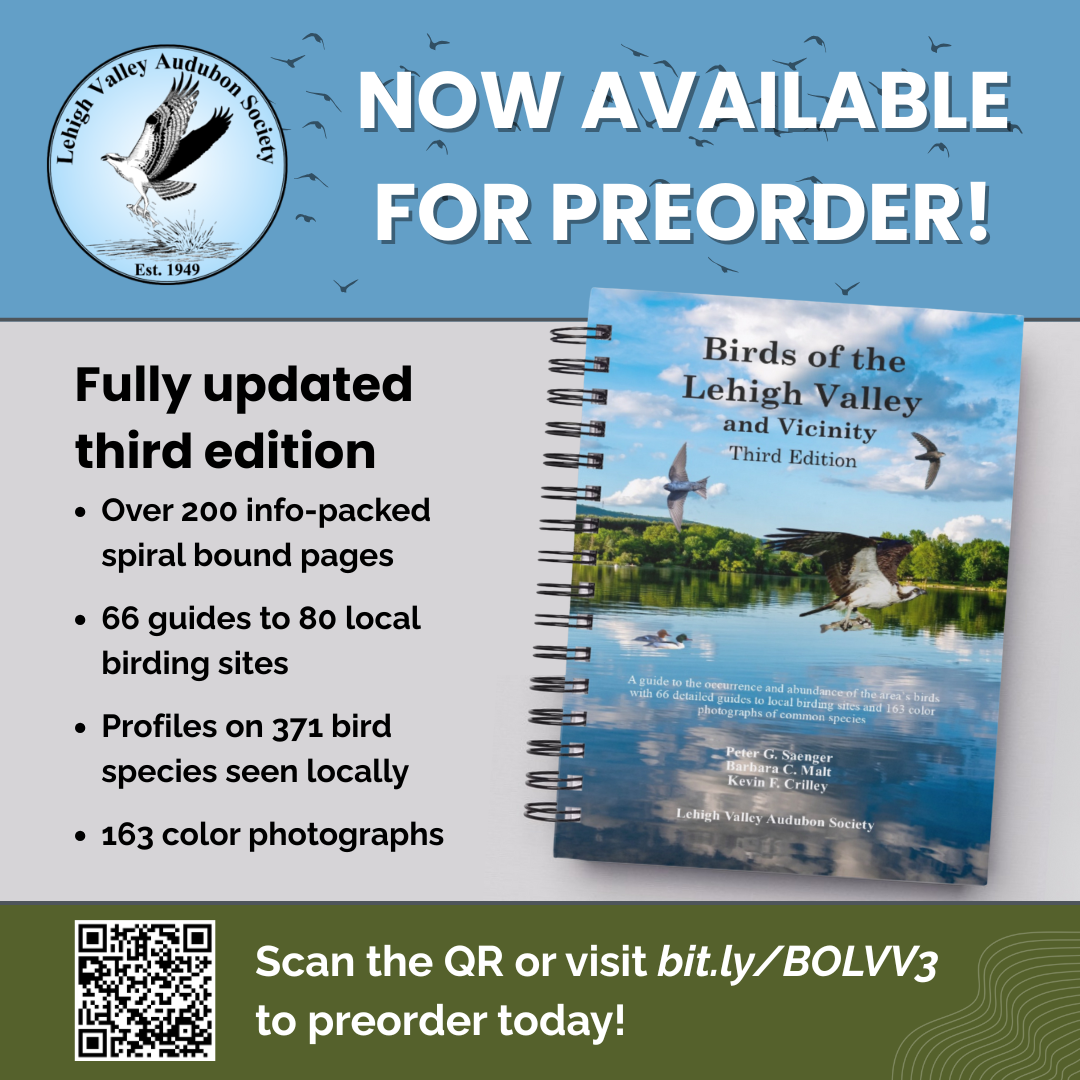
Fully revised and now available: Birds of the Lehigh Valley and Vicinity, 3rd Edition

LVAS has been documenting our local birds for over ninety years and published data in a book, Birds of the Lehigh Valley and Vicinity.

The fully revised 3rd edition is now available for preorder here in our online Shop!

The book is currently at the printer, and we hope to ship in time for Christmas or shortly thereafter. Either way, be one of the first to receive this brand new edition of our popular guidebook (6,000 copies sold since first published)!

Hawk Watching at Blue Mountain Ski Area

Saturday, Nov 1 · 8:30 AM to 10:30 AM EDT

Blue Mountain Ski Area

1660 Blue Mountain Dr · Palmerton, PA

Meet at the overlook, just past the Slope Side Grill and Bar. Dress warm as it is usually colder at hawk watching sites. If conditions aren't good for hawk migration then we will go for a bird walk in the valley below. For hawk watching there is no hiking required. Bring drink and snacks. There are heated bathrooms in the ski lodge. Trip leader is Mark Boyd (610-657-9401)