


Discovering Our Native Bees Zoom Program

Learn about Pennsylvania’s Native Bees with Lehigh Valley Audubon Society’s Karen Campbell

 Zoom Meeting on Mar 21, 2025

07:00 PM Eastern Time (US and Canada)

Join us to kick-off Spring 2025 by discovering some of the bee-utiful bees that are in our yards, gardens, and local wild places!

Pennsylvania has as many species of bees as birds, but they're easy to miss until you know what to look for!

Bee on Echinacea. Photo: Karen Campbell

Bee on Echinacea. Photo: Karen Campbell

You'll learn:

  • how and why bees gather pollen yet unwittingly pollinate plants in the process.

  • and discover that some insects you think are bees are imitators.

  • easy ways to support native bees.

Karen Campbell authors Bugs for Birds for our quarterly Osprey newsletter. She's an award-winning macro photographer, Certified Pollinator Steward, and is completing her qualifications as a Pennsylvania Master Naturalist.

Please register in advance for a fascinating evening, by clicking the link below.  https://muhlenberg.zoom.us/meeting/register/cE1oUuARQyGoA7e4io_T-w

Note:  You may register at any time up to the start of the meeting.
After registering, you will receive a confirmation email containing information about joining the meeting.

Never miss an event!

Become a member of Lehigh Valley Audubon Society to be notified of future educational programs, guided walks, volunteer opportunities, and all of our latest activities.

Birding Trip to Round Valley and Spruce Run Recreation Areas, in NJ

Saturday, March 15, 2025

Join LVAS on a Field Trip to Round Valley Recreation Area, New Jersey's largest body of fresh water.

MEET AT 8:00 AM at the Park-n-Ride, Rte. 33 and William Penn Highway

RSVP through Meetup or Mobilize

Great Blue Heron, juvenile, Round Valley Reservoir, Hunterdon county, New Jersey. Photo: Kent Stuart/Audubon Photography Awards

Map of meeting area at William Penn Highway Park and Ride

Although we will observe all birds that we find, the focus of this trip will be waterfowl, which are some of our most beautiful birds.

Expect a nice variety of waterfowl to be at these locations.

This is a carpooling event.

If you would like to drive, please make sure that you have a full tank of gas in your car.

If you would rather ride, then be prepared to chip in for gas and tolls.


Never miss an event!

Become a member of Lehigh Valley Audubon Society to be notified of future educational programs, guided walks, volunteer opportunities, and all of our latest activities.
Map showing field trip location at Round Valley Recreation Area, NJ

Glue Traps Kill Birds! Use Circle Traps to Control Spotted Lanternflies More Effectively.

Goldfinch trapped on a sticky trap wrapped around a tree trunk, under the chicken wire that failed to protect bycatch from the trap intended for Spotted Lanternflies (SLFs) - photo from Pocono Wildlife Rehabilitation

Even with wire and mesh coverings, glue traps (sticky bands) intended for Spotted Lanternflies (SLFs) remain dangerous, and unintended bycatch, like the Goldfinch in this photo, still occurs.

Wildlife Rehabilitators receive victims trapped on protected glue tape/ sticky band traps. Insects are still captured and birds will crawl in for a meal. Also, mesh can fall off or be pulled off by a squirrel on the trunk.

Need more convincing? View the Glue Victims Gallery.

Fortunately, scientists have learned that Circle Traps are more effective at trapping SLFs than sticky tape.

And you can buy circle traps or read Penn State Extension’s directions on how to make Spotted Lanternfly Circle Traps.

Spread the word about the dangers of glue traps and the benefits of circle traps using our social media kit.

Engage with Lehigh Valley Audubon Society to Help Preserve Birds and Habitat!
Become a
member, volunteer &/or donor.

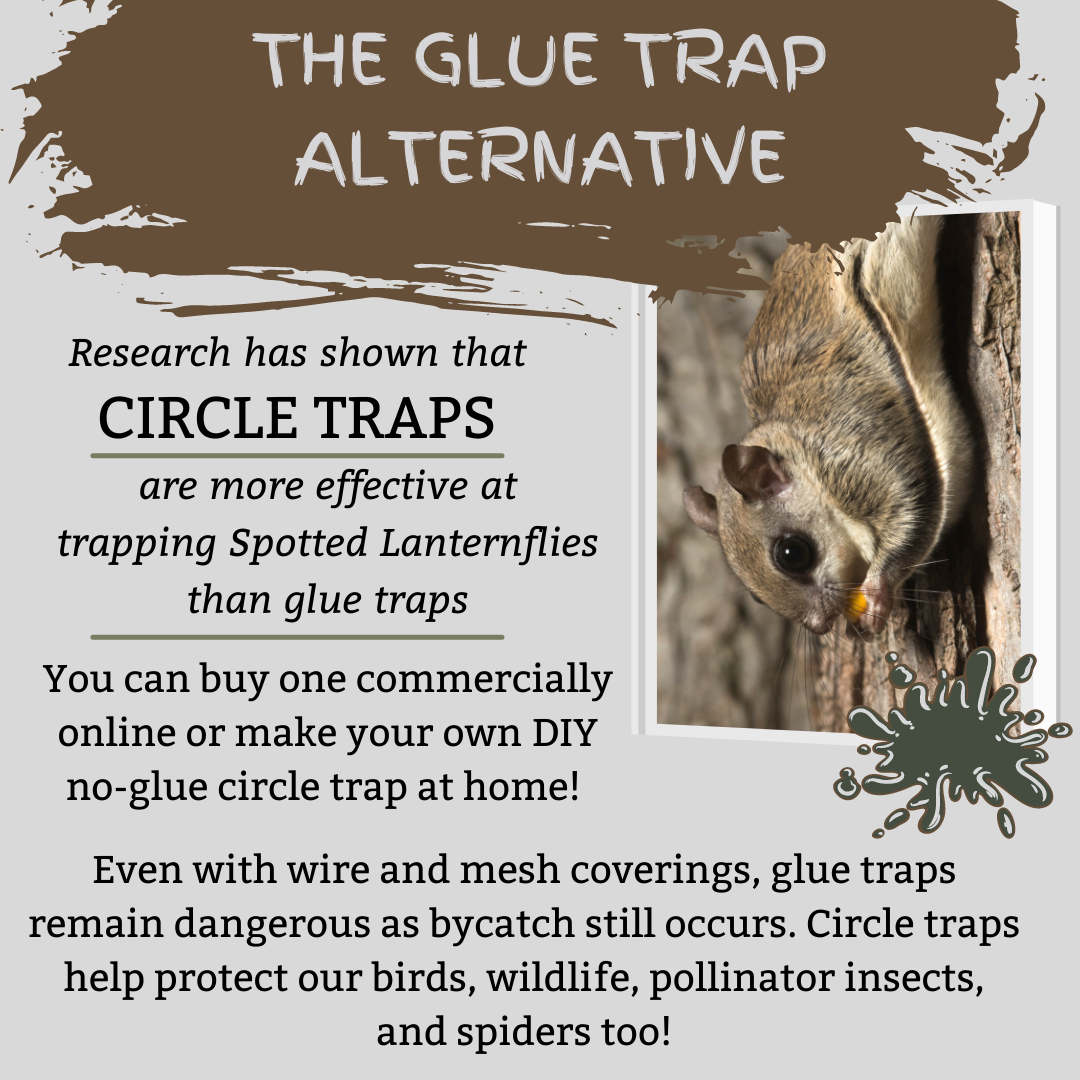
Circle Traps: The Glue Trap Alternative Flyer

Glue Traps Kill Birds! Use Circle Traps to Control Spotted Lanternflies More Effectively.

Goldfinch trapped on a sticky trap wrapped around a tree trunk, under the chicken wire that failed to protect bycatch from the trap intended for Spotted Lanternflies (SLFs) - photo from Pocono Wildlife Rehabilitation

Even with wire and mesh coverings, glue traps (sticky bands) intended for Spotted Lanternflies (SLFs) remain dangerous, and unintended bycatch, like the Goldfinch in this photo, still occurs.

Wildlife Rehabilitators receive victims trapped on protected glue tape/ sticky band traps. Insects are still captured and birds will crawl in for a meal. Also, mesh can fall off or be pulled off by a squirrel on the trunk.

Need more convincing? View the Glue Victims Gallery.

Fortunately, scientists have learned that Circle Traps are more effective at trapping SLFs than sticky tape.

And you can buy circle traps or read Penn State Extension’s directions on how to make Spotted Lanternfly Circle Traps.

Circle Traps: The Glue Trap Alternative Flyer

Spread the word about the dangers of glue traps and the benefits of circle traps using our social media kit.

Engage with Lehigh Valley Audubon Society to Help Preserve Birds and Habitat!
Become a
member, volunteer &/or donor.

Engage in 2nd Season of 5 Year PA Bird Atlas 3

The Pennsylvania Bird Atlas needs volunteers and is hiring Seasonal Research Technicians

We hope that some of you helped to gather data for Season 1 of the 3rd Pennsylvania Bird Atlas (PBA3) and that more of you will help with the 2nd Season of this 5-year-long survey that will end February 2029.

Pennsylvania birders of all ages and skill levels began working together in early 2024 to map the breeding and status of bird species in the state. Read An Atlaser’s Guide to Season Two to plan your participation this year.

This project is supported by the PA Game Commission (PGC), headquartered at Hawk Mountain, and facilitated by Cornell Lab’s eBird online tools. The PGC initiated this project to update the information they need to prioritize conservation actions and to protect the birds of Pennsylvania.

Read the PA Bird Atlas 3 Volunteer Handbook to learn more about how to participate.

Findings will guide conservation for years to come.

In addition to volunteers, Pennsylvania Bird Atlas is hiring a team of seasonal point count technicians to conduct surveys throughout Pennsylvania during the summer of 2025.

Read all the job details and how to apply here.

April 18, 2025 is the Deadline to Apply to be a Paid Seasonal Research Technician for Pennsylvania Bird Atlas, but applications will be reviewed upon receipt.

Employment Dates: May 19 – mid July 2025

Preference will be given to applicants with previous point count experience and eBird experience. Prior birding experience need not be through a paid position, but ability to identify birds of Pennsylvania by sight and sound required.

CALL TO ACTION!

As bird lovers, we understand that a healthy environment is essential to the well-being of not just birds, but of all species, including humans. Unfortunately, recent federal actions will have direct negative impacts on birds and the lands we share with them. These include regulatory rollbacks that will be destructive to public lands by allowing more pollution and harmful extractive activities, mass firings of federal employees who have critical roles in maintaining the health of our public lands, withholding of grant funds to clean up or protect the environment, and discontinuation of programs to limit the effects of climate change.

The health of nature transcends politics, affecting every single one of us. And the U.S. has long had a strong bipartisan consensus in support of conservation.

We encourage everyone reading this message to step up now to defend the birds you love and the environment that sustains us.

Multiple bird species in water under “Call to action!” heading.

How?

As a start, call your member of Congress (in the Lehigh Valley, that’s Ryan Mackenzie, (202) 225-6411) and your two Senators (in PA, that’s John Fetterman, (202) 224-4254 and Dave McCormick, 202-224-6324). Ask them (or their voicemail ) to preserve – not cut! – funding for programs that protect the environment, support clean energy, and maintain our National Parks, National Forests, National Wildlife Refuges and other key bird habitats.

THE HOUSE IS EXPECTED TO VOTE ON A BUDGET RESOLUTION THIS WEEK (Feb. 24-28), SO CALLS TO RYAN MACKENZIE SHOULD BE MADE ASAP!

You might also consider:
• Signing up for Audubon’s Action Network, at https://www.audubon.org/takeaction
• Visiting the advocacy page of the League of Conservation Voters, at https://www.lcv.org/get-involved/#take-action-online
• Calling your lawmakers on a regular basis. Other topics might include: asking that personnel fired from agencies such as the Environmental Protection Agency and the National Park Service be reinstated; opposing the undermining of the Migratory Bird Treaty Act and the Endangered Species Act; and opposing expanded drilling and mining on public lands, including species-rich habitats such as the Arctic National Wildlife Refuge.

Lastly, Lehigh Valley Audubon Society is considering creating a Rapid-Response team – bird/nature lovers interested in being contacted about time-sensitive environmental and bird-conservation-related issues, with suggested scripts for contacting lawmakers.

If you would be interested in participating – or have any questions or suggestions -- please send an email to conservation@lvaudubon.org.

If you’re not a member of our Community Chapter of Audubon, please join and/or volunteer to help with our ongoing Lehigh Valley preservation, advocacy, and education efforts.